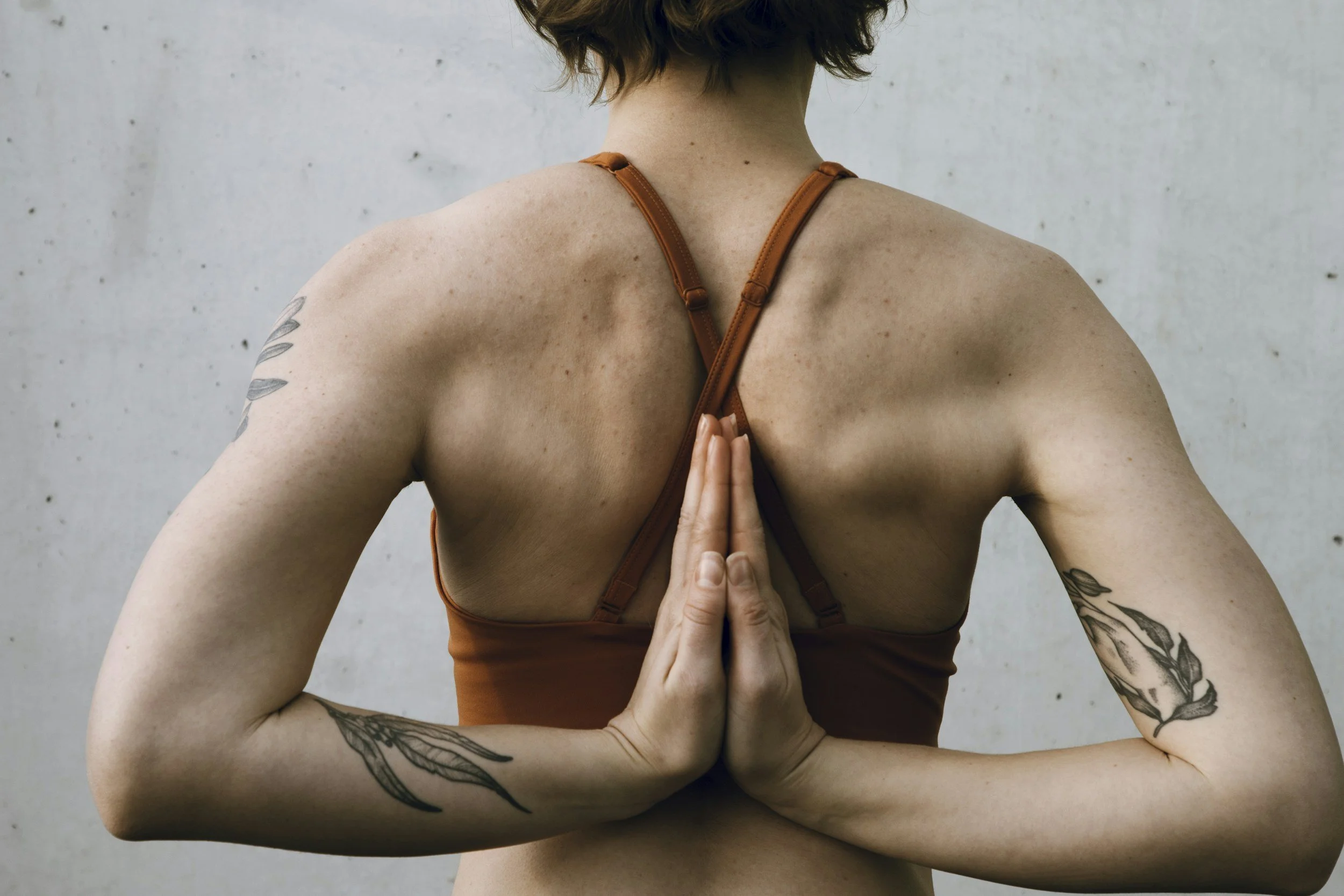
Practice On The Mat (Sadhana)

Asana
-
What is Āsana?
Āsana (आसन) is a Sanskrit word meaning 'seat' or 'posture'.
Today, we often associate āsana with the physical postures and movement sequences practised in yoga classes. However, its roots extend much deeper than physical exercise.
In Patañjali's Yoga Sūtras, āsana is described through the qualities of sthira and sukha, commonly understood as steadiness and ease.
-
Sthira Sukham Āsanam
Yoga Sūtra 2.46The posture is steady and easeful.
This offers us a beautiful principle for approaching physical practice: cultivating stability without rigidity, and ease without collapse.
Rather than striving to achieve the perfect shape, we begin to explore the relationship between effort and softness, strength and receptivity, movement and stillness.
-
Why Do We Practise Āsana?
Āsana offers us an opportunity to explore our embodied experience with greater awareness.
Through physical practice, we can cultivate strength, mobility, balance, coordination and a more intimate understanding of how our bodies move and respond.
But the benefits of āsana need not end with the physical body.
Our practice can also become a place to explore our relationship with challenge, discomfort, expectation and control.
We might begin to notice:
Where do I create unnecessary tension?
How do I respond when something feels difficult?
Can I recognise the difference between productive effort and strain?
Am I listening to my body, or trying to make it conform to an expectation?
What happens when I approach movement with curiosity rather than judgement?
In this way, āsana becomes more than a series of postures. It becomes an opportunity to develop awareness, sensitivity and discernment.
-
How Can I Begin?
You don't need an elaborate sequence or an hour of uninterrupted time to explore āsana at home.
Begin somewhere comfortable, perhaps seated, lying down or standing.
Take a moment to notice the sensations of your body.
Feel your connection with the ground. Notice your breathing. Become curious about where your attention naturally travels.
Then begin to move.
Perhaps you'll gently circle your shoulders, stretch your arms, move your spine, shift your weight or explore a familiar posture from class.
You might choose to stay in one position for several breaths, noticing the subtle changes that arise.
Rather than asking yourself what a posture should look like, explore:
What am I experiencing? What feels supportive? Where is there effort? Where might I soften?
Allow your breath to remain comfortable, and let your movements respond to what you discover.
There is no particular sequence you need to complete.
The invitation is to move with awareness, rather than simply move through shapes.
-
Different Ways to Explore Āsana
There are many approaches to physical yoga practice, each offering different qualities and opportunities for exploration.
Dynamic movement and flow
Moving between postures with awareness and intention, exploring rhythm, coordination, strength and the relationship between breath and movement.
Stillness and sustained postures
Remaining in a comfortable position for a period of time, observing sensation, attention and the subtle experience of change.
Restorative practice
Using props and supportive positions to encourage rest, comfort and a sense of being held.
Somatic and intuitive movement
Exploring movement through internal sensation rather than predetermined shapes, allowing curiosity and the body's feedback to guide the experience.
Strength and balance
Developing stability, coordination and confidence while exploring our relationship with effort, concentration and challenge.
None of these approaches is inherently more advanced or valuable than another.
Different practices may nourish us at different times.
-
Beyond the Mat: Life Is the Altar
One of the gifts of āsana is that it can reveal how we relate to our experiences beyond the mat.
Perhaps you notice a tendency to push yourself beyond what's necessary.
Perhaps you discover how quickly you become frustrated when something doesn't happen as expected.
Or perhaps you begin to recognise that steadiness doesn't require hardness, and softness doesn't mean weakness.
These discoveries can accompany us into our relationships, our work, our responsibilities and the countless ordinary moments of living.
We might begin asking:
Can I meet difficulty without immediately tightening against it?
Can I find steadiness while life is changing around me?
Can I respond to my needs without judging them?
The qualities we explore through āsana can become qualities we practise in the way we live.
The posture is not the destination. It is one doorway into a deeper relationship with ourselves and life.
Movement, posture & the art of embodiment.
An Invitation to Explore
The next time you practise, choose one familiar posture.
Rather than concentrating on how it looks, spend a little time noticing how it feels.
Explore your connection with the ground, the quality of your breathing and the relationship between effort and ease.
Notice what changes when you stop trying to perfect the posture and begin to experience it.
And when you leave your mat, carry one small discovery into your day.
What might it mean to embody steadiness and ease in the way I meet life?

Prāṇāyāma
Breath, vital energy & the art of inner awareness
-
What is Prāṇāyāma?
Prāṇāyāma (प्राणायाम) is a Sanskrit term commonly understood as the regulation or expansion of prāṇa, the vital life energy described within yogic traditions.
Prāṇa is often translated as 'life force' or 'vital energy', while āyāma can refer to extension or expansion. The term is also traditionally understood in relation to the regulation of breath.
Although prāṇāyāma is often introduced as a collection of breathing exercises, its significance within yoga extends far beyond the mechanics of inhaling and exhaling.
In the yogic understanding, breath and prāṇa are intimately connected. By working skilfully with breathing, we begin to explore the relationship between our physical experience, attention, energy and awareness.
In Patañjali's Yoga Sūtras, prāṇāyāma is the fourth limb of the eight-limbed path.
-
Tasmin sati śvāsa-praśvāsayor gati-vicchedaḥ
Yoga Sūtra 2.49This sūtra describes prāṇāyāma in relation to the regulation or interruption of the movement of inhalation and exhalation, once steadiness in posture has been established.
Prāṇāyāma is therefore more than simply taking deep breaths to relax. It is a contemplative discipline through which we develop a subtler awareness of breathing, attention and the movements of our inner experience.
-
Why Do We Practise Prāṇāyāma?
Our breathing is constantly responding to life.
It changes when we move, rest, concentrate, laugh, cry, feel excited or encounter difficulty.
Often, these changes happen without our conscious awareness.
Through prāṇāyāma, we begin to notice this intimate relationship between breath, body and mind.
Different breathing practices may support us in different ways, including cultivating concentration, developing awareness of habitual breathing patterns, and encouraging relaxation or a sense of steadiness.
But the intention isn't always to make ourselves calmer.
Sometimes the practice is simply to recognise what is happening, without immediately needing to change it.
We might begin to explore:
How does my breath respond to different experiences?
Do I habitually hold, restrict or force my breathing?
Can I notice my breath without trying to improve it?
What happens to my attention when I become more aware of breathing?
Can I find a relationship with breath that feels gentle, spacious and unforced?
Over time, breath becomes not just something we do, but something we learn to listen to.
-
How Can I Begin?
You don't need to change your breathing to begin exploring it.
Find a comfortable position, perhaps seated, standing or lying down.
Allow your body to feel supported.
If it feels comfortable, gently bring your attention towards your natural breathing.
Notice the movement of the inhale.
Notice the movement of the exhale.
You might sense the breath at your nostrils, through the movement of your ribs, or in the gentle rise and fall of your abdomen.
There's no need to make the breath longer, slower or deeper.
Simply observe.
You may notice that some breaths feel spacious and others feel shallow. Some may be smooth, while others seem irregular.
Allow this variation.
If concentrating on your breathing feels uncomfortable, return your attention to the sounds around you or the support beneath your body.
For now, the practice is simply to become acquainted with your breath, exactly as it is.
-
Different Ways to Explore Prāṇāyāma
There are many traditional approaches to working with breath, each with its own methods, qualities and intentions.
Natural Breath Awareness
A gentle starting point for observing the breath without deliberately changing its rhythm.
This can help us develop sensitivity to the subtle movements of breathing and their relationship with attention.
Dīrgha Prāṇāyāma | Three-Part Breath
A contemporary teaching name for a practice exploring breathing through the abdomen, ribcage and upper chest.
It can help students become more aware of breathing movements, without needing to force the lungs to fill completely.
Nāḍī Śodhana | Alternate-Nostril Breathing
A traditional practice associated with balancing and purifying the subtle channels (nāḍīs) within yogic understandings of the energetic body.
Gentle versions may support focused attention and a more settled breathing rhythm.
Bhrāmarī | Humming Bee Breath
A practice involving a soft humming sound during exhalation.
The gentle vibration and sound offer an accessible point of focus and may encourage relaxation.
Ujjāyī | Victorious Breath
A traditional breathing technique involving a gentle narrowing of the throat, creating a subtle, audible breath.
It is often used in contemporary movement-based yoga to cultivate attention and a steady rhythm.
Kumbhaka | Breath Retention
The intentional holding or suspension of breath, explored in several traditional prāṇāyāma practices.
This is a more specialised aspect of practice and should be learned progressively with appropriate individual guidance, rather than attempted through general written instructions.
Different techniques are not interchangeable, and more intense is not necessarily more beneficial.
A comfortable, unforced breath is a valuable place to begin. Students should avoid straining, prolonged breath-holding or techniques that cause dizziness or breathlessness.
-
Bringing Prāṇāyāma Into Your Personal Sādhana
You might begin by spending just a few minutes each day noticing your natural breathing.
Perhaps you sit quietly before breakfast.
Perhaps you observe your breath after a walk, before meditation, or at the beginning of your physical yoga practice.
As your familiarity grows, we can explore other techniques together during your 1:1 sessions, gradually discovering what feels appropriate and supportive for you.
Some days you may feel drawn towards a structured breathing practice.
Other days, quietly observing the natural breath may be enough.
Rather than collecting techniques or trying to reach a particular state, allow your relationship with breath to develop through curiosity, consistency and care.
-
Beyond the Mat: Life Is the Altar
Breath is one of the most immediate expressions of our relationship with life.
We breathe while speaking, listening, loving, working, resting, celebrating and grieving.
It accompanies us through every ordinary and extraordinary moment.
And yet, we so rarely notice it.
Through prāṇāyāma, we may begin to recognise how intimately our breathing is woven into our experiences.
Perhaps we notice ourselves holding our breath during a difficult conversation.
Perhaps we become aware of how our breathing changes when we step outside into fresh air.
Or perhaps we discover a quiet moment of presence while washing the dishes, walking home or sitting beside somebody we love.
Not every breath needs to be controlled.
Not every feeling needs to be regulated.
Sometimes the invitation is simply to recognise the breath as an expression of life moving through us.
The breath does not separate us from the world. It reminds us that we are participating in it.
An Invitation to Explore
Today, choose one ordinary moment to notice your breathing.
Perhaps while waiting for the kettle to boil, sitting at your desk, walking outside or preparing to go to sleep.
For a few moments, allow your attention to rest gently on your natural breath.
Notice its rhythm, movement and quality.
Resist the urge to immediately make it slower or deeper.
Simply become curious.
Then ask yourself:
What changes when I stop trying to control my experience and begin listening to it?
Remember, your breath is not something you need to perfect.
It is something you can learn to meet with greater sensitivity, respect and awareness.
-
What is Dhyāna?
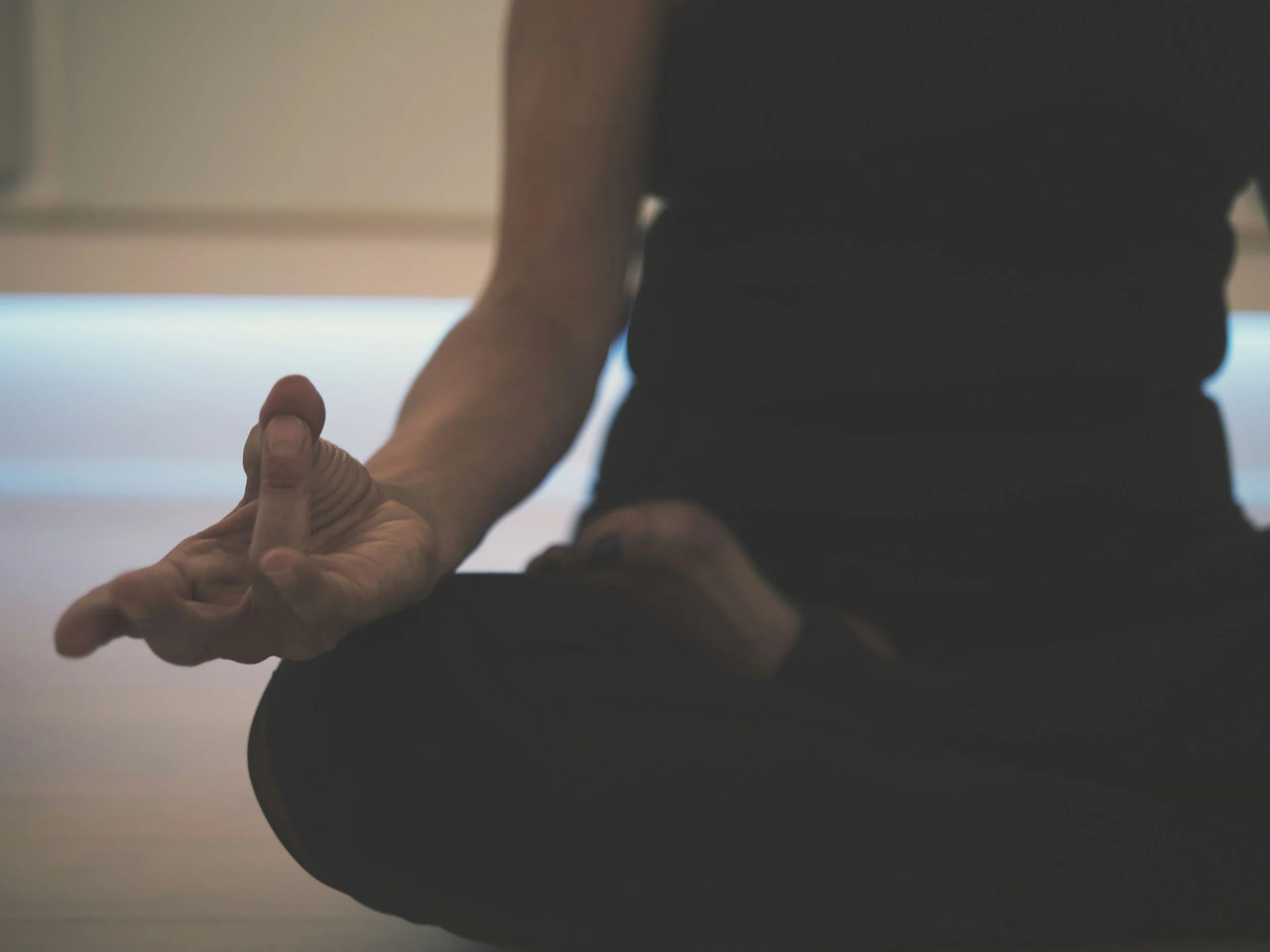
Dhyāna (ध्यान) is a Sanskrit word commonly translated as meditation.
Within classical Yoga, dhyāna refers specifically to a sustained, uninterrupted flow of attention towards an object of contemplation.
It is the seventh limb of Patañjali's eight-limbed system, following dhāraṇā (concentration) and preceding samādhi(meditative absorption).
-
Tatra pratyayaikatānatā dhyānam
Yoga Sūtra 3.2Meditation is the continuous flow of cognition towards the chosen object.
This understanding invites us to recognise meditation as more than sitting quietly or trying to relax. It is a deepening of attention, through which the movements of the mind and our relationship with experience may become clearer.
Within non-dual Tantrik traditions, meditation can also take the form of recognising awareness itself, exploring the nature of consciousness and discovering the sacred within our immediate experience.
Different traditions understand the purposes and methods of meditation differently, but they share an invitation towards deeper exploration.
Meditation is not necessarily about becoming thoughtless, achieving a special state or escaping the world.
It is an opportunity to become more intimate with our experience of being alive.
-
Why Do We Practise Meditation?
Our attention is continually moving.
Throughout the day, we find ourselves remembering, imagining, planning, analysing, anticipating and reacting.
Often, we become so absorbed in these movements that we scarcely notice them happening.
Meditation offers an opportunity to develop a different relationship with attention and experience.
Through regular practice, we might begin to cultivate greater concentration, awareness, patience, emotional understanding and the capacity to notice our habitual reactions.
But meditation need not always produce calm.
Sometimes, when we become still, we encounter restlessness, discomfort, sadness, frustration or thoughts that have previously gone unnoticed.
These experiences don't necessarily mean we're meditating incorrectly.
The invitation is to develop the sensitivity and discernment to meet what arises, without automatically becoming consumed by it or needing to change it.
We might begin to explore:
Where does my attention naturally go?
What happens when I notice a thought without following it?
How do I relate to feelings I find uncomfortable?
Can I recognise the difference between awareness and the experiences appearing within it?
What becomes possible when I stop trying to manufacture a particular state?
Meditation can become a process of discovery rather than an attempt at self-improvement.
-
How Can I Begin?
Find a place where you feel comfortable and reasonably undisturbed.
You might sit on a cushion, chair or the floor, or choose another supported position.
There's no need to adopt a particular posture, provided you feel comfortable and able to remain gently attentive.
Allow your gaze to soften or close your eyes, whichever feels more supportive.
Begin by noticing the contact of your body with the surface beneath you.
Become aware of the sounds around you.
Notice your natural breathing, without needing to control it.
Then choose somewhere to rest your attention.
This might be the sensation of breathing, a sound, a mantra or a simple point of contact within the body.
When you notice that your mind has wandered, gently return to your chosen focus.
You may find yourself returning many times.
This is part of the practice.
Begin with just a few minutes.
You don't need to force concentration or push through discomfort. If closing your eyes or focusing inward feels unsettling, keep your eyes open and explore attention through an external sound, object or the surrounding environment.
Meditation isn't a test of how long you can remain focused. It is an opportunity to become familiar with the movements of attention.
-
Different Ways to Explore Meditation
Meditation encompasses many approaches, with different methods, purposes and philosophical foundations.
Focused Attention | Dhāraṇā
Resting attention on a chosen object, such as the breath, a mantra, a visual point or a sound.
This develops familiarity with concentration and the movement of attention.
Breath Awareness
Gently observing natural breathing, noticing its rhythm, sensations and changes without deliberately controlling it.
Mantra Meditation
Using the repetition of a sound, word or sacred phrase as a focal point for attention.
Mantra may be spoken aloud, whispered or repeated silently, depending on the practice and tradition.
Trāṭaka | Gazing Practice
Resting the gaze on a chosen object, traditionally including a flame or visual point, as a means of cultivating concentration.
This is approached gently, without forcing the eyes or staring through discomfort.
Open Awareness
Allowing sounds, sensations, thoughts and feelings to arise within awareness, without deliberately choosing one object to concentrate upon.
Rather than following every experience, we practise recognising its appearance and passing.
Self-Inquiry
Exploring questions about identity, awareness and our relationship with thoughts and experiences.
Rather than seeking an immediate intellectual answer, we allow the inquiry to invite direct observation and contemplation.
Tantrik Meditation
Within non-dual Śaiva Tantra, meditation may involve mantra, visualisation, contemplative inquiry, subtle-body practices and recognition of consciousness as the fundamental reality of experience.
Some practices are accessible introductions to awareness, while others belong to specific traditional contexts and are best learned through qualified guidance.
No single approach is necessarily right for everyone.
Your practice may change as your experience and understanding deepen.
-
Bringing Meditation Into Your Personal Sādhana
A sustainable meditation practice often begins with simplicity.
Rather than deciding you must meditate for thirty minutes every morning, consider creating a small, regular opportunity to sit and observe.
Perhaps you begin with three minutes after waking.
Perhaps you practise after āsana, when movement has helped you settle.
Perhaps you enjoy repeating a mantra before beginning your day.
Consistency can offer a foundation, but flexibility allows that foundation to remain supportive.
Some days your attention may feel clear and steady.
Other days your mind may seem particularly busy.
Neither experience needs to determine whether the practice was worthwhile.
Over time, we can explore different meditation approaches together during our 1:1 sessions, discovering which techniques resonate with you and how they support your wider life.
Your personal sādhana doesn't need to become elaborate.
It simply needs to offer a meaningful opportunity to return.
-
Beyond the Cushion: Life Is the Altar
Meditation is not something we leave behind when we open our eyes.
The awareness we explore in formal practice is also present while we speak, listen, work, love, create and navigate the complexities of being human.
Perhaps you begin to notice a familiar reaction arising during a difficult conversation.
Perhaps you recognise the tendency to rush through a beautiful moment while thinking about what comes next.
Perhaps you become aware of the space between feeling an emotion and deciding how to respond.
These moments offer opportunities to bring the discoveries of meditation into life.
Within non-dual Tantrik philosophy, the ordinary world is not necessarily something to transcend or reject. It can be understood as an expression of consciousness, and therefore as a place where recognition becomes possible.
This does not mean we must remain peaceful, detached or unaffected by suffering.
Awareness can deepen our capacity to feel, respond, care and participate more fully in the world.
We don't meditate to become less human.
We practise to meet our humanity with greater presence, wisdom and openness.
Life itself is the altar.
Dhyāna & Meditation
Awareness, contemplation & the art of recognising what is already here
An Invitation to Explore
Find somewhere comfortable and give yourself five minutes.
Allow your body to settle.
Choose one simple point of attention, perhaps a sound, your natural breathing or the contact of your feet with the ground.
When thoughts arise, notice them.
When your attention wanders, gently return.
There's nothing to achieve and no particular feeling you need to create.
Afterwards, take a moment to reflect:
What did I notice about the way my attention moves?
How did I respond when my experience wasn't what I expected?
Could I bring a little of this curiosity into the ordinary moments of my day?
Remember that meditation is not about perfecting the mind.
It is an ongoing exploration of awareness, and of what it means to be fully present within this extraordinary experience of living.
Mantra & Sacred Sound
Voice, vibration & the transformative power of sound
-
What Is Mantra?
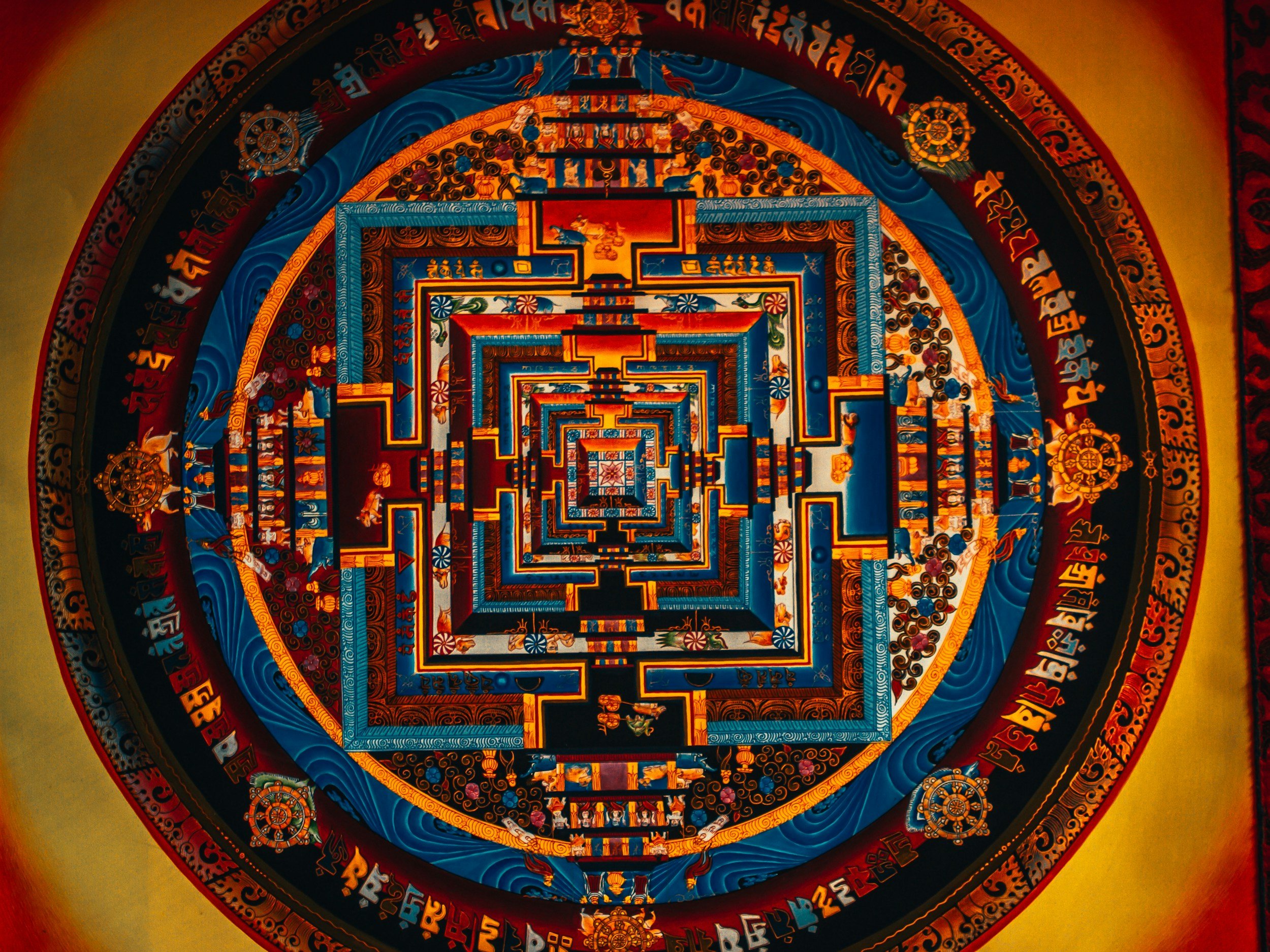
Mantra (मन्त्र) is a Sanskrit term referring to a sacred sound, syllable, word or phrase used within spiritual and contemplative practice.
Mantras have been part of Indian spiritual traditions for thousands of years, appearing in Vedic, yogic, Tantrik and other contexts.
Although mantra is sometimes described as a tool for focusing or calming the mind, its traditional significance is much richer.
Depending on the tradition, a mantra may be understood as a sacred utterance, an expression of divine presence, a means of contemplation or a powerful form of spiritual practice.
Within non-dual Śaiva Tantra, sound and consciousness are intimately related. Certain mantras are understood not merely as symbols of the sacred, but as expressions or embodiments of divine power (śakti).
In this understanding, mantra is not simply something we use to achieve a particular state.
It can become a pathway towards recognising the sacred nature of consciousness and our participation in it.
-
Why Do We Practise Mantra?
Sound has a remarkable capacity to engage our attention.
We experience it not only through hearing, but through the movement of the breath, the activity of the voice and the sensations of vibration within the body.
Through mantra practice, we may begin to explore a more intimate relationship with sound, attention and awareness.
Repetition can provide a steady focal point for meditation, while chanting aloud may offer a sense of expression, connection and embodied presence.
Some people experience mantra as calming or grounding. Others find it energising, moving or emotionally evocative.
Within traditional spiritual contexts, the purpose of mantra may also include devotion, worship, ritual, contemplation, purification or recognition of one's deeper nature.
We might begin to explore:
What happens when I allow myself to make sound?
Can I listen as attentively as I chant?
How does the experience of sound change when I repeat it?
What do I notice in the moments of silence between repetitions?
Can I approach mantra with curiosity, reverence and openness rather than trying to achieve a particular result?
Mantra invites us to explore not only the sound itself, but the awareness in which sound is experienced.
-
How Can I Begin?
You don't need a beautiful singing voice, musical experience or an understanding of Sanskrit to begin exploring sacred sound.
Find somewhere comfortable, perhaps seated on a cushion or chair.
Take a moment to notice your natural breathing.
Begin with a gentle hum as you exhale, allowing the sound to remain soft and comfortable.
Notice the sensation of vibration.
Notice the experience of listening to your own voice.
Allow a little silence afterwards.
When you feel ready, you might explore the sound OṂ (ॐ), often written as OM or AUM.
OṂ is a sacred syllable found across several Indian spiritual traditions, with rich philosophical and spiritual significance.
Chant it softly at a comfortable pitch, without straining your throat or extending the breath beyond what feels natural.
Afterwards, pause.
Notice the transition from sound into silence.
There is nothing you need to manufacture or feel.
Simply explore the experience.
If chanting aloud feels uncomfortable, you might begin by listening or silently repeating a familiar mantra.
Mantra is not a performance. It is a practice of attention, relationship and, often, devotion.
-
Different Ways to Explore Mantra
Mantra takes many forms, and different traditions offer distinct approaches to sound and repetition.
Vācika Japa | Audible Repetition
Repeating a mantra aloud, allowing the voice and the ears to participate in the practice.
This can provide an accessible focal point for attention and encourage a more embodied relationship with sound.
Upāṃśu Japa | Soft or Whispered Repetition
Repeating a mantra very quietly, often with slight movement of the lips.
This offers a subtler form of practice between audible and fully mental repetition.
Mānasa Japa | Mental Repetition
Repeating a mantra inwardly without producing an audible sound.
Attention rests on the mantra as it is silently repeated within awareness.
Kīrtan | Devotional Chanting
A form of devotional singing, often practised collectively and sometimes through call and response.
Kīrtan may include divine names, sacred phrases and musical accompaniment.
Bīja Mantra | Seed Syllables
Short sacred syllables associated with particular deities, energies or aspects of Tantrik practice.
These may have specific ritual purposes and traditional methods of transmission.
Ajapa Japa | Spontaneous or Natural Repetition
A traditional contemplative approach associated with recognising mantra as an ongoing or naturally occurring process, sometimes connected with the movement of breathing.
Some mantra practices are widely accessible, while others are traditionally received through initiation or taught within a particular lineage.
It is worth respecting these distinctions rather than treating every mantra as interchangeable.
-
Bringing Mantra Into Your Personal Sādhana
Mantra practice doesn't have to be long or elaborate.
You might begin with a few gentle repetitions of a mantra you've learned during class.
Perhaps you chant OṂ three times before meditation.
Perhaps you practise a familiar mantra quietly while seated, allowing your attention to rest in the sound.
Or perhaps you listen to a recording and simply notice how the sound moves through your experience.
You may find that you enjoy chanting aloud.
You may prefer silent repetition.
You may discover that a particular practice feels meaningful because of its traditional significance, its contemplative quality or your personal relationship with it.
Rather than trying to learn as many mantras as possible, consider developing a deeper relationship with one practice over time.
During our 1:1 sessions, we can explore appropriate mantras together, including their meanings, pronunciation, traditional contexts and how they may support your wider sādhana.
The invitation is to practise with attention, patience and respect.
-
Beyond the Mat: Life Is the Altar
Sound accompanies almost every moment of our lives.
The voices of those we love.
The birds outside our windows.
The rhythm of footsteps.
Laughter, music, rain, conversation and silence.
Through mantra, we may begin to develop a more intimate relationship with listening itself.
Perhaps we become more aware of the words we choose.
Perhaps we notice the quality of our voice when speaking to ourselves or others.
Perhaps we discover how deeply sound can affect us, or how rarely we allow ourselves to truly listen.
Within non-dual Tantrik philosophy, the relationship between sound, expression and consciousness can become a profound field of contemplation.
The sacred is not confined to the sound of a mantra.
Our everyday lives, too, are filled with opportunities to recognise presence, expression and connection.
This doesn't mean that all sounds are pleasant, or that our words and actions carry no consequences.
It invites us to become more conscious of how we listen, speak and participate in the world.
The practice of sacred sound can become the practice of sacred listening.
And listening is something we can carry into every corner of our lives.
An Invitation to Explore
Find a few minutes somewhere comfortable.
Begin by noticing the sounds already present around you.
Rather than labelling or judging them, simply listen.
When you're ready, take a comfortable breath and gently chant OṂ, allowing the sound to unfold naturally.
Repeat two or three times, without forcing your voice or breath.
Then sit quietly.
Notice the space after the sound.
Notice the experience of listening.
You might reflect:
What happens when I listen without needing to respond?
How does my experience of sound change when I give it my full attention?
What might sacred listening look like in my everyday relationships?
As you move through your day, choose one conversation in which to practise listening with your whole attention.
Not to prepare your response, solve a problem or change another person's experience.
Simply to listen.
Let the practice of mantra remind you that your voice matters, your listening matters, and the way you meet the world matters.

Svādhyāya & Self-Inquiry
Self-study, contemplation & the art of knowing ourselves
-
What Is Svādhyāya?
Svādhyāya (स्वाध्याय) is a Sanskrit term commonly translated as 'self-study' or 'study of the self'.
Traditionally, the word also refers to the recitation and study of sacred texts, particularly within the Vedic tradition.
In Patañjali's Yoga Sūtras, svādhyāya is one of the five niyamas, the personal observances that form the second limb of the eight-limbed path.
Alongside practices such as contentment, discipline and surrender, svādhyāya invites us into an ongoing relationship with study, contemplation and spiritual exploration.
But self-study is not simply about analysing our personalities, examining our thoughts or understanding our habits.
It can also become an exploration of the deeper questions of human existence.
Who am I?
What shapes the way I experience the world?
What am I identifying with?
What is aware of my thoughts, feelings and experiences?
Within non-dual Tantrik traditions, particularly Kashmir Śaivism, self-inquiry can also be understood through the lens of pratyabhijñā, or recognition.
This refers to recognising our fundamental nature as consciousness, rather than understanding ourselves solely through the changing experiences, identities and stories of our lives.
Different yogic traditions approach these questions in distinct ways, but they share an invitation towards deeper investigation.
Self-inquiry is not about endlessly trying to fix ourselves. It is about becoming more intimate with the truth of our experience.
-
Why Do We Practise Self-Inquiry?
So much of our experience is shaped by patterns we rarely stop to question.
We develop beliefs about who we are, what we're capable of, what we should want and how life is supposed to unfold.
Some of these beliefs are helpful.
Others may become so familiar that we mistake them for unquestionable truths.
Through self-study and contemplation, we begin to recognise the ways our perceptions, habits and assumptions influence our experience.
We may discover that we are more than the stories we tell about ourselves.
That our thoughts are not always reliable descriptions of reality.
That an emotion can be deeply felt without defining our entire identity.
That we can question familiar patterns while meeting ourselves with compassion.
Through study and inquiry, we might explore:
What beliefs am I carrying about myself?
Which patterns repeatedly appear in my thoughts, relationships and behaviours?
What happens when I become curious rather than immediately judgemental?
How do I distinguish direct experience from the stories I create about it?
What remains present as thoughts, feelings and experiences change?
The intention is not to become perfectly self-aware or to monitor every thought.
It is to cultivate greater clarity, discernment and freedom in how we relate to ourselves and the world.
-
How Can I Begin?
Self-inquiry doesn't require hours of journalling, an extensive knowledge of philosophy or the ability to answer life's biggest questions.
You might begin with a single moment of curiosity.
Find somewhere comfortable and take a few moments to settle.
Notice what is present in your experience.
Perhaps there is a thought, a feeling, a sensation or a particular concern occupying your attention.
Rather than immediately trying to solve or change it, gently ask:
What am I noticing?
Allow yourself to observe the experience.
If a thought is present, recognise it as a thought.
If an emotion is present, notice how it is being experienced.
You might then explore:
What do I know directly, and what am I assuming?
There is no need to find a perfect answer.
You may simply discover that your experience is more spacious, complex or changeable than you first imagined.
If you enjoy writing, you might spend a few minutes journalling afterwards.
If not, you can allow the inquiry to remain a quiet contemplation.
Self-inquiry should be approached with gentleness and discernment. If questioning becomes repetitive, distressing or overwhelming, it's okay to step away, reconnect with your surroundings and return to something grounding.
The invitation is to become curious about experience, not to interrogate yourself.
-
Bringing Self-Inquiry Into Your Personal Sādhana
Self-study can become a gentle and meaningful part of your regular practice.
Perhaps you begin your morning by reading a short passage from a yogic text.
Perhaps you spend five minutes journalling after meditation.
Perhaps you choose one question to contemplate throughout the week.
Or perhaps you simply notice a familiar thought or reaction as it arises in everyday life.
There is no need to make self-inquiry complicated.
You might begin with three questions:
What am I experiencing?
What am I believing about this experience?
Is there another way I could meet it?
Allow your reflections to arise naturally.
Some inquiries may reveal something meaningful immediately. Others may unfold gradually over weeks, months or even years.
There is no requirement to reach a conclusion.
Through our 1:1 sessions, we can explore philosophical teachings and personal reflections together, allowing your understanding to develop alongside your physical, contemplative and everyday practices.
Remember that self-inquiry is not a substitute for emotional support or therapy when these are needed, and you never have to share reflections you would prefer to keep private.
Your sādhana belongs to you.
-
Different Ways to Explore Svādhyāya & Self-Inquiry
There are many ways to develop a meaningful relationship with study, contemplation and self-understanding.
Study of Sacred Texts
Exploring traditional teachings such as the Yoga Sūtras, Bhagavad Gītā, Upaniṣads and Tantrik scriptures.
Rather than simply collecting philosophical knowledge, we consider how teachings might illuminate our own experience and inform the way we live.
Reflective Journalling
Writing as a way of exploring our thoughts, emotions, questions, insights and experiences.
Journalling can help us recognise patterns, process discoveries and return to meaningful inquiries over time.
Contemplation
Spending time with a particular question, passage or teaching.
Rather than searching for an immediate intellectual answer, we allow the inquiry to deepen through reflection and direct experience.
Witnessing Thoughts & Patterns
Developing awareness of the habitual movements of the mind.
We might begin recognising recurring assumptions, reactions and identifications without automatically believing or rejecting them.
Ātma-Vicāra | Self-Inquiry
A form of inquiry particularly associated with Advaita Vedānta and the teachings of Ramana Maharshi, often centred on the question 'Who am I?'
Rather than seeking a conceptual description of the self, the practice investigates the nature of the one who experiences.
Pratyabhijñā | Recognition
Within non-dual Kashmir Śaivism, recognition refers to the realisation of one's fundamental identity with Śiva, understood as the universal consciousness.
This is not simply a process of observing personality traits or understanding psychological patterns, but a profound philosophical and contemplative approach to recognising the nature of reality and one's own being.
Dialogue & Shared Inquiry
Exploring philosophical questions through conversation, discussion and shared reflection.
Sometimes our understanding deepens not through solitary contemplation, but through listening to another perspective, questioning assumptions and discovering together.
Each of these offers a different doorway into understanding.
You are welcome to explore what resonates, while remaining open to perspectives that challenge or expand your current understanding.
-
Beyond the Mat: Life Is the Altar
Everyday life offers countless opportunities for self-inquiry.
We encounter ourselves through relationships, responsibilities, decisions, disappointments, pleasures and unexpected changes.
Perhaps somebody says something that leaves us feeling defensive.
Perhaps we notice ourselves comparing our lives with somebody else's.
Perhaps an ordinary moment of beauty interrupts a familiar pattern of worrying about the future.
These moments can reveal how we experience the world and how deeply our perceptions shape our responses.
Rather than seeing everyday challenges as interruptions to spiritual practice, we can begin to recognise them as opportunities for exploration.
This doesn't mean we must analyse everything, justify harmful experiences or accept circumstances that need to change.
Sometimes awareness calls us to rest.
Sometimes it calls us to establish boundaries, speak honestly, offer care or take meaningful action.
Within the non-dual Tantrik vision, our ordinary human experiences need not be separated from the possibility of spiritual recognition.
We can explore the nature of awareness while remaining fully engaged with life.
We can study philosophy while caring deeply about the world.
We can question our identities without denying our humanity.
Life is not an obstacle to our practice. Life itself is the altar.
An Invitation to Explore
Choose a moment in your day when you notice a strong reaction, a familiar thought or an unexpected feeling.
If it feels supportive, give yourself a little space to pause.
You might ask:
What am I experiencing right now?
What story am I telling myself about this?
What do I know to be true in this moment?
Rather than trying to immediately resolve the experience, see whether you can meet it with curiosity.
You might write about it later, speak about it with somebody you trust or simply allow the moment to pass.
Then consider:
What does this experience reveal about my habitual ways of seeing?
How might greater awareness influence the way I respond?
What would it mean to meet this moment with both compassion and discernment?
Remember, the purpose of self-inquiry is not to become endlessly preoccupied with ourselves.
It is to cultivate the understanding and freedom that allow us to participate in life more fully.
We study ourselves not to become trapped within our own minds, but to discover the possibility of living beyond their familiar limitations.
There are many doorways into practice, but the invitation is always to bring what we discover into the way we live.
We move, breathe, meditate, chant, study and inquire not simply to become more accomplished practitioners, but to deepen our relationship with ourselves, one another and this extraordinary experience of being alive.
Life is the altar.