Music & Mantra
Mantra Library
Sacred sound, living wisdom & the practice of remembrance.
Mantra has been woven into the spiritual traditions of India for thousands of years. Passed from teacher to student, carried through generations of practice, these sacred sounds invite us into a different relationship with our minds, our bodies and the world around us.
In the yogic and Tantric traditions, mantra is more than a collection of words or a tool for relaxation. Sound itself can become a doorway into awareness, devotion and the recognition of our deeper nature.
This library is a growing collection of mantras for you to explore as part of your personal sādhana (spiritual practice).
Each offering includes its traditional meaning and context, guidance for pronunciation, and invitations to listen, chant and contemplate.
You don’t need to know Sanskrit, have a beautiful singing voice or consider yourself particularly spiritual to begin.
Come with curiosity. Listen deeply. Allow the practice to unfold.
May these sounds become familiar companions on your journey.
The Library Collection
Here are some primary deities to work with - these will be continually added to and updated.
Ganesha Mantra:
Oṃ Gaṃ Gaṇapataye Namaḥ
An invocation to Gaṇeśa: wisdom, beginnings and the removal of obstacles.
-
ॐ गं गणपतये नमः
Oṃ Gaṃ Gaṇapataye Namaḥ
Om Gam Ganapataye Namaha
-
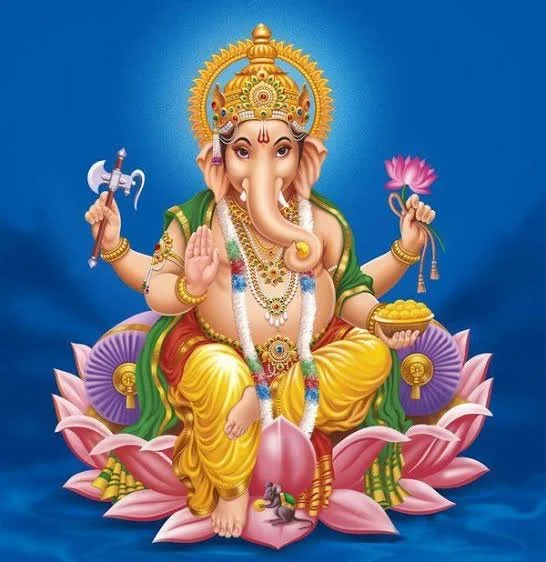
This mantra is an invocation to Gaṇeśa, the beloved elephant-headed deity of the Hindu traditions, traditionally associated with wisdom, discernment, new beginnings and the removal of obstacles.
Gaṇeśa is often honoured at the beginning of a journey, a new undertaking or spiritual practice.
The mantra is a simple expression of reverence:
Oṃ: The sacred syllable, traditionally associated with ultimate reality and the fullness of existence.
Gaṃ: The bīja, or seed syllable, associated with Gaṇeśa.
Gaṇapataye: To Gaṇapati, another name for Gaṇeśa.
Namaḥ: A bow, salutation or offering of reverence.
Together, the mantra can be understood as:
“I bow to Gaṇeśa.”
-
In traditional practice, Gaṇeśa is not simply understood as a remover of external difficulties, but is also associated with wisdom and discernment.
We might contemplate obstacles not only as things standing in our way, but as opportunities to recognise our habitual patterns, fears, attachments and ways of relating to life.
Sometimes the obstacle changes. Sometimes our relationship with it changes.
Rather than using mantra to force a particular outcome, we can approach the practice as an invitation to listen, soften and develop greater clarity.
-
Find a comfortable position, perhaps seated or lying down.
Allow yourself a few moments to settle, noticing the natural movement of your breath.
Begin by listening to the mantra or gently repeating it aloud.
You may wish to chant slowly, allowing each repetition to find its own natural rhythm.
Notice the vibration of sound within the body.
Notice the quality of attention that accompanies repetition.
You might find yourself chanting loudly, softly, rhythmically or almost in a whisper.
There is no need to force a particular experience.
After a few minutes, allow the repetition to come to an end.
Sit quietly.
Notice what remains when the sound dissolves into silence.
-
What am I currently experiencing as an obstacle?
Is there something in my relationship with this experience that I am willing to see differently?
What might it mean to meet this moment with greater wisdom, rather than resistance?
-
Listen to the mantra
https://www.youtube.com/watch?v=R6hoBIYZ9_E&list=RDR6hoBIYZ9_E&start_radio=1
Continue exploring
You may like to return to this mantra at the beginning of your day, before meditation, or when approaching something new.

Shiva Mantra:
Oṃ Namaḥ Śivāya
An invocation to Śiva: consciousness, reverence & the recognition of our true nature.
-
ॐ नमः शिवाय
Oṃ Namaḥ Śivāya
Om Namah Shivaya
-
Oṃ Namaḥ Śivāya is one of the most revered mantras within the Śaiva traditions of Hinduism.
At its heart is the five-syllabled mantra Namaḥ Śivāya, known as the Pañcākṣarī Mantra, which has ancient roots in the Śrī Rudram of the Yajurveda. When preceded by Oṃ, it is commonly called the Ṣaḍakṣarī, or six-syllabled mantra.
The mantra is a salutation to Śiva, whose name is traditionally associated with that which is auspicious, gracious and benevolent.
Oṃ: The sacred syllable, associated with the fullness of existence and ultimate reality.
Namaḥ: A bow, salutation or expression of reverence.
Śivāya: To Śiva, the auspicious one.
Together, the mantra can be understood as:
“I bow to Śiva.”
Or, in a more contemplative sense:
“I offer reverence to the auspicious consciousness that is the essence of all things.”
The second interpretation reflects a non-dual Śaiva understanding, rather than a literal word-for-word translation.
Who Is Śiva?
Śiva is one of the principal deities of Hinduism, traditionally associated with transformation, dissolution, meditation and liberation.
He is often depicted seated in deep meditation, dwelling upon Mount Kailāsa, with a crescent moon resting in his hair, the river Gaṅgā flowing through his locks and a serpent resting around his neck.
These images carry rich layers of symbolism and invite contemplation of the relationship between stillness and movement, creation and dissolution, form and formlessness.
Within non-dual Kashmir Śaivism, Śiva is understood not simply as a divine being separate from us, but as the limitless, self-aware consciousness that is the ground of all existence.
Śiva and Śakti are inseparable.
Śiva represents consciousness, while Śakti is its intrinsic power of awareness, expression and manifestation.
They are not two competing forces, but two inseparable aspects of one reality.
Through this understanding, spiritual practice becomes not only a movement towards the sacred, but a gradual recognition that the sacred has never been absent.
-
We often move through life feeling ourselves to be separate individuals, looking out upon a world that exists independently of us.
Our minds become occupied with thoughts, identities, responsibilities, desires and fears.
Yet beneath these changing experiences is the simple fact of awareness itself.
The capacity to know that we are here.
Within non-dual Śaiva philosophy, this awareness is not considered an isolated personal possession. It is understood as an expression of universal consciousness.
When we chant Oṃ Namaḥ Śivāya, we might explore what it means to bow not only to a divine form, but to the consciousness through which every experience is known.
The mantra becomes an invitation to recognise rather than to acquire.
Not to become something other than we are, but to inquire more deeply into the nature of what we already are.
-
Find a comfortable seated position.
Allow your body to settle naturally, without needing to become perfectly still.
Feel the contact between your body and the ground beneath you.
Notice your breath moving in and out.
Begin repeating the mantra gently:
Oṃ Namaḥ Śivāya.
You may chant aloud, softly whisper or repeat the mantra inwardly.
Allow the sound to find its own rhythm.
Notice the vibration of the voice, the movement of the breath and the quality of attention accompanying each repetition.
You don’t need to push thoughts away.
Let sounds, sensations and thoughts come and go, while gently returning to the mantra.
After several minutes, allow the repetition to come to an end.
Rest in silence.
Notice that although the sound has dissolved, awareness remains.
You might gently contemplate:
What is it that knows this silence?
There is no need to find an intellectual answer.
Simply rest with the question.
-
What does it mean to bow to something sacred?
Can I recognise awareness even when my thoughts and emotions are changing?
What happens when I stop trying to create a particular experience and become curious about the one already unfolding?
-
Listen to the mantra
https://www.youtube.com/watch?v=vmNjc_EzQx8&list=RDvmNjc_EzQx8&start_radio=1
Continue exploring
You might return to this mantra during morning meditation, before personal study or whenever you wish to reconnect with the simple experience of being aware.
Allow the practice to become familiar over time, without needing to measure its success.
Saraswati Mantra:
Oṃ Aiṃ Sarasvatyai Namaḥ
An invocation to Sarasvatī: wisdom, creativity & the sacred flow of expression.
-
ॐ ऐं सरस्वत्यै नमः
Oṃ Aiṃ Sarasvatyai Namaḥ
Om Aim Saraswatyai Namaha
-
Oṃ Aiṃ Sarasvatyai Namaḥ is a devotional mantra honouring Sarasvatī, the Hindu goddess associated with wisdom, knowledge, speech, music, learning and the arts.
Sarasvatī has ancient roots in the Vedic traditions, where she is associated with a sacred river and praised as a divine presence. Over time, her significance develops within Hindu traditions as the goddess of learning, eloquence and creative expression.
She is often honoured by students, musicians, writers, artists and spiritual seekers.
The mantra offers a simple expression of reverence:
Oṃ: The sacred syllable, associated with ultimate reality and the fullness of existence.
Aiṃ: A bīja, or seed syllable, traditionally associated with Sarasvatī, knowledge and speech.
Sarasvatyai: To Sarasvatī.
Namaḥ: A bow, salutation or offering of reverence.
Together, the mantra can be understood as:
“I bow to Sarasvatī.”
The seed syllable Aiṃ is traditionally understood as carrying a significance beyond its literal meaning, particularly within Tantric practices.
Who Is Sarasvatī?
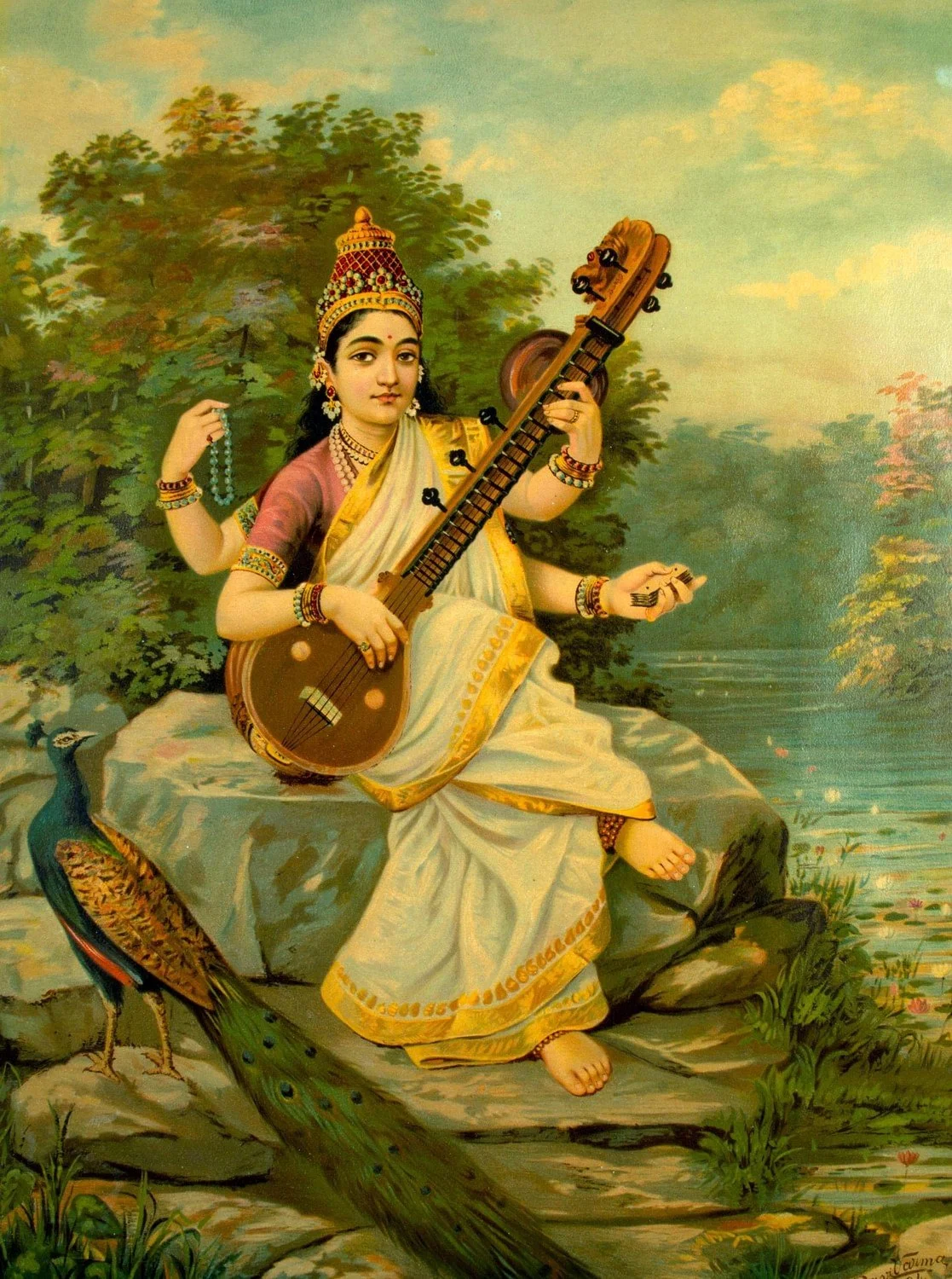
Sarasvatī is traditionally depicted dressed in white, seated upon a lotus or beside a flowing river, often holding a vīṇā, a classical Indian stringed instrument.
She is associated with knowledge, music, language, clarity and the refinement of understanding.
Her imagery invites contemplation of wisdom not simply as something we accumulate, but as something we cultivate through attention, study, practice and experience.
The flowing river is a particularly beautiful symbol through which to contemplate Sarasvatī: knowledge and creative expression need not be static, but may continually move, deepen and transform.
Within devotional traditions, Sarasvatī is honoured as a divine presence whose grace supports learning, eloquence and artistic expression.
-
So often, we approach creativity and learning with an expectation that we should already know what we are doing.
We want to understand quickly, express ourselves beautifully or arrive at something complete.
And yet, so much of genuine learning asks us to remain open to what we do not yet know.
To listen.
To make mistakes.
To practise.
To allow our understanding to change.
Through the invocation of Sarasvatī, we might explore a different relationship with learning and expression.
Rather than needing to force creativity or collect more information, we can begin by cultivating receptivity.
What becomes possible when we allow ourselves to be students of life?
What might emerge when we create without needing to know the outcome?
The mantra becomes an invitation to honour both the wisdom we have received and the wisdom that is still unfolding.
-
Find a comfortable position, allowing your body to settle.
Take a few moments to notice your breath and the sounds around you.
Perhaps bring to mind something you are currently learning, creating or exploring.
Without needing to solve or understand anything, simply acknowledge your relationship with it.
Begin repeating the mantra:
Oṃ Aiṃ Sarasvatyai Namaḥ.
You may choose to chant aloud or listen to a recording.
Allow the sound to move naturally, without trying to make your voice beautiful or perfect.
Notice the sensations of sound within the mouth, throat and body.
Notice what happens when you give your attention fully to listening.
After several repetitions, gently allow the mantra to fall away.
Sit quietly for a few moments.
You might contemplate the possibility that learning begins not only with knowing, but with our willingness to listen.
-
Where in my life am I being invited to become a student again?
Can I approach something unfamiliar with curiosity rather than judgement?
What might I create or express if I were less concerned with getting it right?
How might I honour the teachers, traditions and experiences that have shaped my understanding?
-
Listen to the mantra
https://www.youtube.com/watch?v=QNXpalxX7VQ&list=RDQNXpalxX7VQ&start_radio=1
Continue exploring
You may wish to return to this mantra before study, writing, artistic practice or moments of contemplation.
Allow it to become an opportunity to cultivate humility, receptivity and a deeper appreciation for the gift of learning.